

Team CloudSource Blog
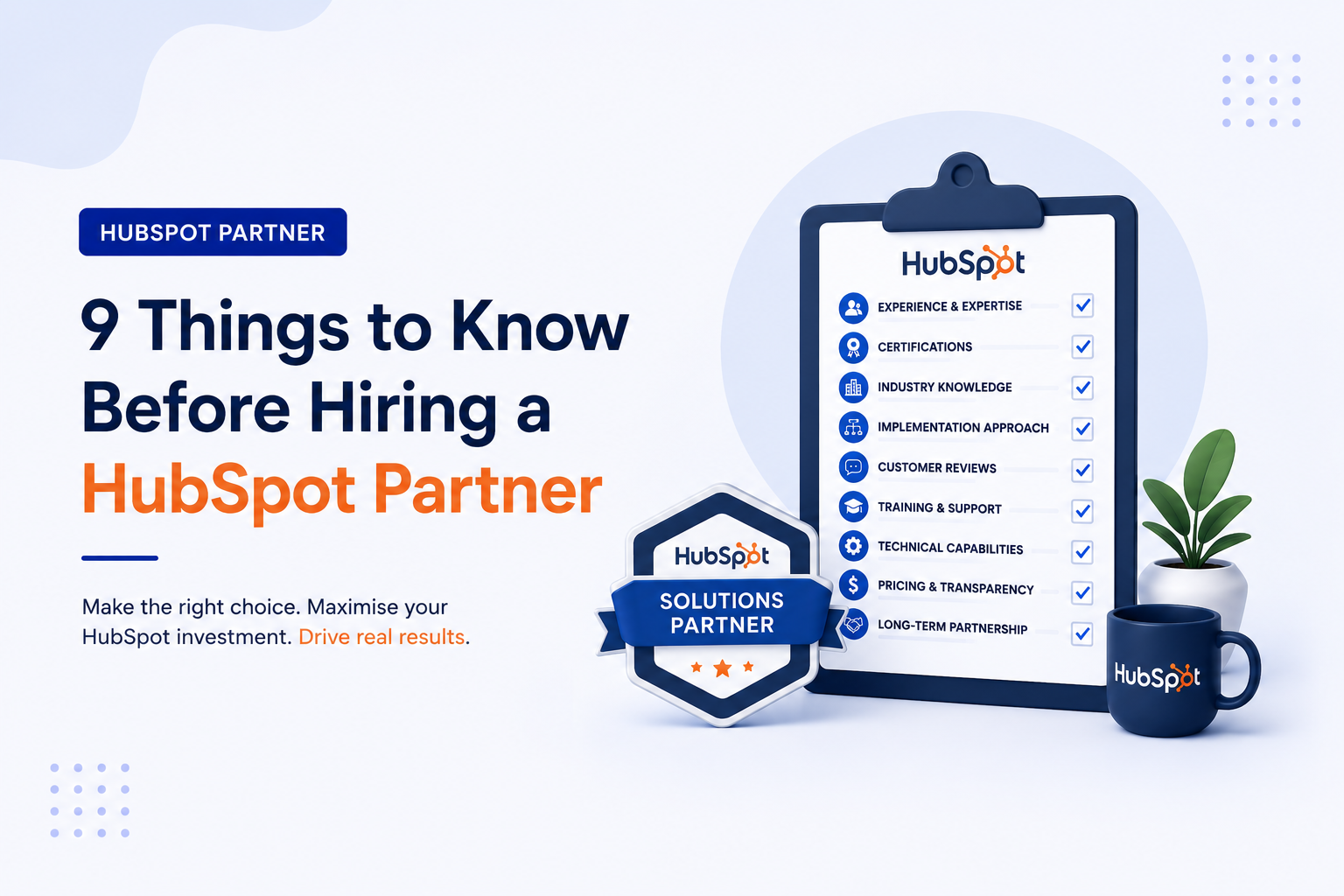
9 Things to Know Before Hiring a HubSpot Partner
-
Yaghsha Dawar
-
Jul 27, 2026 6:52:12 PM
Quick guide: 9 things small businesses should know before hiring a HubSpot partner
- Team CloudSource: APAC's top-rated HubSpot implementation partner for SMBs needing ongoing support and custom integrations
- Partner tier matters: Diamond and Elite partners must meet client retention standards
- Integration capability: Your partner should connect HubSpot to your existing tools
- Ongoing support model: Ask about post-launch retainer options and response times
- APAC experience: Local market knowledge affects implementation success
- RevOps vs execution: Know whether you need strategy or just configuration
- Team composition: Find out who will work on your account
- Onboarding approach: Custom setups outperform template-based implementations
- Success metrics: Your partner should define clear KPIs from day one
How we identified the key evaluation criteria for HubSpot partners?
Finding the right HubSpot partner is one of the most important decisions you'll make for your CRM investment. The wrong choice can leave you with a system that doesn't fit your sales process, poor adoption, and lost revenue.
We developed this guide based on what APAC small businesses should prioritise when evaluating implementation partners:
- Track record with SMBs: Partners who understand the resource constraints and growth goals of smaller businesses
- Integration depth: The ability to connect HubSpot with Salesforce, Shopify, and other platforms your business relies on
- Support model: Clear post-launch support structures rather than build-and-exit approaches
- Regional expertise: Understanding of APAC business practices, compliance requirements, and time zones
- Certification and retention: HubSpot's partner tiers reflect client retention rates, not just sales volume
- RevOps capability: Whether the partner can architect your revenue operations or just configure software.
The 9 things small businesses should know before hiring a HubSpot partner
1. Team CloudSource: APAC's top-rated HubSpot partner for SMB implementations
Team CloudSource is a HubSpot Diamond Partner in the top 2% globally, recognised as APAC's Revenue Partner for 2024. With a 98.6% project success rate and 44+ verified 5-star reviews, the team has built a reputation for helping small businesses get HubSpot right from day one.
What makes Team CloudSource different is the focus on revenue outcomes rather than just software configuration. The Zero Leak framework identifies where your pipeline loses deals, then builds HubSpot workflows to close those gaps. This means your CRM becomes a revenue protection tool rather than just a contact database.
For APAC small businesses, Team CloudSource offers a single retainer that replaces the need for multiple RevOps specialists. You get access to expertise across marketing, sales, service operations, data management, and AI capabilities without hiring individual specialists for each function.
Team CloudSource features
- Multi-hub implementations: Full setup across Marketing Hub, Sales Hub, Service Hub, CMS Hub, and Operations Hub configured for your specific business model
- Custom API integrations: Connect HubSpot with your existing ERP, accounting software, or industry-specific tools through tailored integrations
- AI-powered lead scoring: Breeze AI activation that surfaces your highest-value prospects automatically
- Executive dashboards: Real-time pipeline visibility and MRR tracking built within weeks of implementation
- Data migration: End-to-end CRM migration with deduplication, enrichment, and validation from Salesforce, Zoho, or other platforms
- Ongoing management: Monthly operational support including workflow monitoring, data hygiene, and pipeline cleanup through managed services
Team CloudSource pros and cons
Pros:
- APAC-based team with local support and time zone alignment
- Single retainer covers multiple RevOps functions
- Proven track record with SMBs in SaaS, PropertyTech, and professional services
Cons:
- Best suited for businesses ready to commit to a structured implementation process
- Focus on revenue operations may be more than businesses needing basic marketing automation
- Implementation timeline depends on your existing data quality and system complexity
2. Partner tier indicates client retention, not just sales volume
HubSpot's partner programme assigns tiers based on three factors: licensing volume, sourced deals, and crucially, gross revenue retention (GRR). Diamond partners must maintain at least 75% GRR, meaning their clients continue using and expanding HubSpot over time.
This matters because a partner with high retention rates has likely built systems that teams adopt and rely on daily. Low retention often signals implementations that looked good on paper but failed to stick.
When evaluating partners, ask for their current tier and how long they've held it. A partner who recently achieved Diamond status through a single large deal is different from one who has maintained that tier for years. Team CloudSource has earned Diamond status through consistent SMB implementations across APAC, with clients ranging from education providers to real estate developers.
Partner tier features
- GRR requirements: Diamond partners maintain 75%+ client retention; Elite requires 80%+
- Certification density: Higher tiers require more certified team members across HubSpot's product suite
- Review period: Tiers are evaluated twice yearly based on trailing performance
Partner tier pros and cons
Pros:
- Tier status provides a standardised benchmark for partner quality
- Retention requirements mean tiered partners have proven client success
- Higher tiers unlock additional HubSpot support and resources for your project
Cons:
- Tier alone doesn't indicate specialisation in your industry or business size
- New partners may have excellent capabilities but haven't accumulated enough points
- Regional specialists may be better fits than larger global agencies with higher tiers
3. Custom integration capability separates good partners from great ones
Your HubSpot implementation doesn't exist in isolation. You likely have accounting software, an ERP system, e-commerce platforms, or industry-specific tools that need to share data with your CRM.
Ask potential partners about their integration experience. Can they connect HubSpot to Xero for invoice automation? Have they built custom API connections to property management systems? Do they understand how to sync HubSpot with Salesforce if your enterprise clients require it?
Team CloudSource builds connected systems that remove manual data entry between platforms. Rather than treating integrations as add-ons, the approach treats your entire tech stack as one revenue system. This reduces the risk of data silos that lead to missed follow-ups and lost deals.
Integration capability features
- Native integrations: Setup of HubSpot's built-in connections with common platforms
- Custom API development: Building bespoke connections for industry-specific or legacy systems
- Data mapping: Ensuring fields sync correctly between systems without duplication or data loss
Integration capability pros and cons
Pros:
- Eliminates manual data entry and reduces errors across systems
- Creates a single view of customer interactions regardless of where they occur
- Automates workflows that span multiple platforms
Cons:
- Complex integrations require more implementation time
- Legacy systems may have limited API capabilities
- Ongoing maintenance is needed when connected systems update
4. Ongoing support models vary significantly between partners
Implementation is the starting point, not the destination. Your business will evolve, your sales process will change, and HubSpot will release new features. You need a partner who stays engaged after launch.
Some partners operate on a build-and-exit model. They complete the implementation, hand you documentation, and move on. Others offer structured retainers with defined deliverables: workflow refinements, reporting updates, data hygiene, and training refreshers.
Ask about response times, escalation processes, and what's included versus billed separately. Team CloudSource offers monthly managed services that include workflow monitoring, pipeline cleanup, and proactive recommendations rather than just reactive support tickets.
Support model features
- Retainer structures: Monthly hours or scope-based agreements for ongoing work
- Response SLAs: Guaranteed response times for support requests
- Proactive monitoring: Partners who identify issues before you report them
Support model pros and cons
Pros:
- Structured retainers provide predictable costs and ongoing expertise
- Partners familiar with your setup resolve issues faster
- Continuous improvement keeps your HubSpot aligned with business changes
Cons:
- Monthly retainers add to ongoing operational costs
- Some businesses prefer managing HubSpot internally after initial training
- Support scope must be clearly defined to avoid unexpected charges
5. APAC experience affects implementation success for regional businesses
Working with a partner who understands APAC business practices makes a measurable difference. Local partners know the compliance landscape, the common tech stacks in your market, and the buyer behaviours that affect your sales process.
Time zone alignment matters more than many businesses realise. When you need urgent support during your business hours, a partner on the other side of the world creates delays. Team CloudSource operates from APAC, meaning support requests during Singapore, Malaysia, or Australian business hours get same-day responses.
Regional expertise also means understanding how businesses in your market typically structure their sales teams, report on performance, and manage customer relationships. A partner who has implemented HubSpot for dozens of APAC SMBs brings pattern recognition that accelerates your setup.
APAC experience features
- Local compliance knowledge: Understanding of regional data privacy and business requirements
- Time zone support: Responsive assistance during your working hours
- Market-specific case studies: Proven results with businesses similar to yours in the region
APAC experience pros and cons
Pros:
- Communication happens during your business hours without scheduling difficulties
- Partners understand regional market dynamics and buyer expectations
- References from similar businesses are easier to verify
Cons:
- Smaller regional partner pools may limit options
- Global agencies offer broader resources for complex enterprise needs
- Multi-region businesses may need partners with global coordination capabilities
6. RevOps capability versus execution-only determines your outcome
There's a significant difference between a partner who configures HubSpot and one who architects your revenue operations. Execution partners handle the technical setup: pipelines, workflows, email templates, and reports. RevOps partners start by understanding how your business generates and closes revenue, then design HubSpot to support that model.
If you're implementing HubSpot to fix a broken sales process, an execution partner will automate your existing problems. A RevOps partner will help you identify what should change before touching the platform.
Team CloudSource operates at the RevOps layer. Engagements start with mapping your lead-to-revenue flow, identifying where deals stall or leak, and designing HubSpot around the process you need rather than the process you have. This approach takes longer upfront but delivers systems your team will use and trust.
RevOps capability features
- Process design: Mapping your sales stages, qualification criteria, and handoff workflows before configuration
- Attribution modelling: Tracking which channels and campaigns generate closed revenue
- Forecast accuracy: Building pipelines that produce reliable revenue predictions
RevOps capability pros and cons
Pros:
- Systems built around your actual revenue model drive higher adoption
- Process gaps are identified and addressed during implementation
- Marketing, sales, and service alignment improves from the start
Cons:
- RevOps engagements require more discovery time upfront
- Leadership involvement is needed for process decisions
- May be more capability than businesses with simple sales processes need
7. Team composition determines your day-to-day experience
Agencies pitch their senior consultants during sales conversations. Your project may be handed to junior staff after you sign. Ask specifically who will work on your account and what their experience includes.
Request LinkedIn profiles or bios for your assigned team. Check their HubSpot certifications and ask about recent projects similar to yours. A certified team with 40+ credentials across Marketing, Sales, Service, CMS, and Operations Hub has demonstrated depth that a smaller team cannot replicate.
Team CloudSource assigns named consultants to each engagement so you know exactly who will be configuring your HubSpot, training your team, and providing ongoing support. This accountability improves outcomes because your consultant understands your business context.
Team composition features
- Named resources: Specific consultants assigned to your project rather than a rotating pool
- Certification density: Multiple HubSpot certifications across the team indicate depth
- Industry experience: Prior work with businesses in your sector
Team composition pros and cons
Pros:
- Consistent relationships improve communication and context retention
- Certified specialists bring platform expertise to complex challenges
- You can reference prior work before committing
Cons:
- Smaller teams may have capacity constraints during busy periods
- Single-point dependencies create risk if your consultant leaves
- Senior resource involvement typically increases project costs
8. Custom onboarding outperforms template-based implementations
Some partners use templated setups to speed implementation. You receive a standard configuration that matches what dozens of other businesses got. This works for simple use cases but fails when your sales process has unique stages or your reporting needs specific metrics.
Ask how much of the implementation will be customised to your business versus based on templates. The right answer depends on your complexity. A straightforward inbound marketing setup might work fine with a template. A multi-product business with different sales cycles needs custom configuration.
Team CloudSource tailors every implementation to how your team sells and services customers. This includes custom deal stages that match your qualification process, sales and marketing handoff workflows designed for your team structure, and dashboards showing the metrics that matter to your leadership.
Onboarding approach features
- Discovery process: Time spent understanding your business before configuration begins
- Custom pipelines: Deal stages and properties that match your sales process
- Training customisation: Onboarding focused on how your team will use HubSpot daily
Onboarding approach pros and cons
Pros:
- Custom setups drive higher team adoption because they match real workflows
- Reporting immediately shows metrics relevant to your business
- Less rework needed after launch to adjust configurations
Cons:
- Custom implementations take longer to complete
- Requires more input from your team during discovery
- Changes to your process mean adjusting the configuration
9. Success metrics should be defined before implementation begins
How will you know if your HubSpot implementation succeeded? If your partner can't answer this clearly, reconsider the engagement.
Good partners define leading and lagging indicators. Leading indicators appear early: team login frequency, data entry completeness, workflow execution rates. Lagging indicators take longer but matter more: pipeline value, closed-won attribution, forecast accuracy improvements.
Team CloudSource builds custom dashboards that track implementation success from day one. You'll see whether your team is using HubSpot, whether leads are progressing through your pipeline, and whether the automation is firing correctly. These metrics create accountability for both you and your partner.
Success metrics features
- Adoption tracking: Monitoring team usage to ensure the system gets used
- Pipeline visibility: Clear view of deal progression and stage conversion rates
- Attribution reporting: Understanding which sources drive closed revenue
Success metrics pros and cons
Pros:
- Clear KPIs create shared accountability between you and your partner
- Early warning signs surface problems before they become costly
- Data-driven decisions replace guesswork about what's working
Cons:
- Metrics require clean data to be meaningful
- Some outcomes take months to measure accurately
- Tracking everything can distract from tracking what matters most
Comparison table: Key factors when evaluating HubSpot partners
| Evaluation Factor | Team CloudSource | Global Agency | Freelance Consultant |
|---|---|---|---|
| APAC Time Zone Support | ✓ | Limited | Varies |
| Multi-Hub Certification | 40+ | Varies | 1-5 |
| Custom API Integrations | ✓ | ✓ | Limited |
| Ongoing Managed Services | ✓ | ✓ | ✗ |
| SMB RevOps Specialisation | ✓ | ✗ | ✗ |
What questions should you ask a HubSpot partner before signing?
Before committing to any HubSpot partner, prepare a list of questions that reveal their true capabilities and fit for your business. The right questions expose whether a partner understands your challenges or just wants to close a deal.
Start with case study requests. Ask for references from businesses similar to yours in industry, size, and complexity. A partner who has helped other APAC SMBs with CRM migrations or custom integrations can share specific examples of challenges they solved.
Then dig into process. How do they approach discovery? What happens if your requirements change mid-project? How are scope additions handled? These operational questions reveal how the partnership will feel day-to-day.
Finally, ask about failure. What implementations haven't worked well, and why? A partner who can honestly discuss challenges demonstrates maturity and will be more realistic about your project's risks.
How do you measure ROI from a HubSpot implementation partner?
Measuring return on your HubSpot investment requires tracking the right metrics at the right time. Immediate metrics include team adoption rates and data completeness. Medium-term metrics include pipeline velocity improvements and lead response times. Long-term metrics include closed-won revenue attributed to HubSpot-managed leads and customer lifetime value changes.
Team CloudSource builds ROI tracking into every implementation through executive dashboards that connect HubSpot activity to revenue outcomes. You'll see how marketing campaigns contribute to closed deals, how quickly leads progress through your pipeline, and where revenue leaks occur.
The goal is making your HubSpot investment measurable rather than a cost you hope is working. When you can point to specific revenue improvements tied to your CRM, future investments become easier to justify.
Why Team CloudSource is the best HubSpot partner for APAC small businesses
Team CloudSource understands that small businesses in APAC face unique challenges when implementing HubSpot. Limited internal resources mean you can't dedicate full-time staff to CRM management. Regional market dynamics require partners who understand how business is done in Singapore, Malaysia, and Australia.
As APAC's top-rated HubSpot Diamond Partner, Team CloudSource delivers implementations configured for your specific business model rather than generic templates. The Zero Leak framework identifies revenue gaps in your sales and marketing processes, then builds HubSpot workflows to close them.
With 44+ verified 5-star reviews and a 98.6% project success rate, Team CloudSource has proven results helping SMBs across SaaS, PropertyTech, education, and professional services. The single-retainer model means you get access to expertise across marketing, sales, service, and data operations without hiring multiple specialists.
Ready to Get More from HubSpot?
Choosing the right HubSpot partner is only the first step. Join our live webinar on 30 July 2026 to discover where your HubSpot setup could be leaking revenue, and how to fix it. Whether you're considering HubSpot or already using it, you'll get practical insights to help you make better decisions and get more from your investment.
Join the webinar and stop the revenue leaks in your HubSpot setup.
FAQs
1. What is a HubSpot implementation partner?
A HubSpot implementation partner is a certified agency that helps you set up, configure, and optimise HubSpot for your business. Team CloudSource goes beyond basic setup by designing revenue operations systems that align your marketing, sales, and service teams around a single data model.
2. How much does a HubSpot implementation cost for small businesses?
HubSpot implementation costs vary based on complexity, number of hubs, and integration requirements. Small businesses should budget for initial implementation plus ongoing support. Team CloudSource offers transparent pricing discussions during your initial consultation to match your specific needs and budget.
3. What's the difference between HubSpot tiers like Gold, Platinum, and Diamond?
HubSpot partner tiers reflect performance metrics including client retention rates and certification depth. Diamond partners like Team CloudSource must maintain at least 75% gross revenue retention, meaning clients continue using and expanding HubSpot over time. This indicates implementation quality rather than just sales volume.
4. Should I choose a local APAC partner or a global HubSpot agency?
For APAC small businesses, local partners offer time zone alignment, regional market understanding, and responsive support during your business hours. Team CloudSource operates from APAC specifically to serve businesses in Singapore, Malaysia, Australia, and surrounding markets with same-day support responses.
5. How long does a typical HubSpot implementation take?
Implementation timelines depend on your scope, data quality, and integration complexity. Team CloudSource typically delivers initial hub setups within weeks while more complex multi-hub implementations with custom integrations take longer. Your consultant will provide a realistic timeline during discovery based on your specific requirements.
6. What ongoing support should I expect after HubSpot implementation?
Quality partners offer structured ongoing support rather than just answering occasional questions. Team CloudSource provides managed services including workflow monitoring, data hygiene, pipeline cleanup, and proactive recommendations to keep your HubSpot performing as your business evolves.