

Team CloudSource Blog
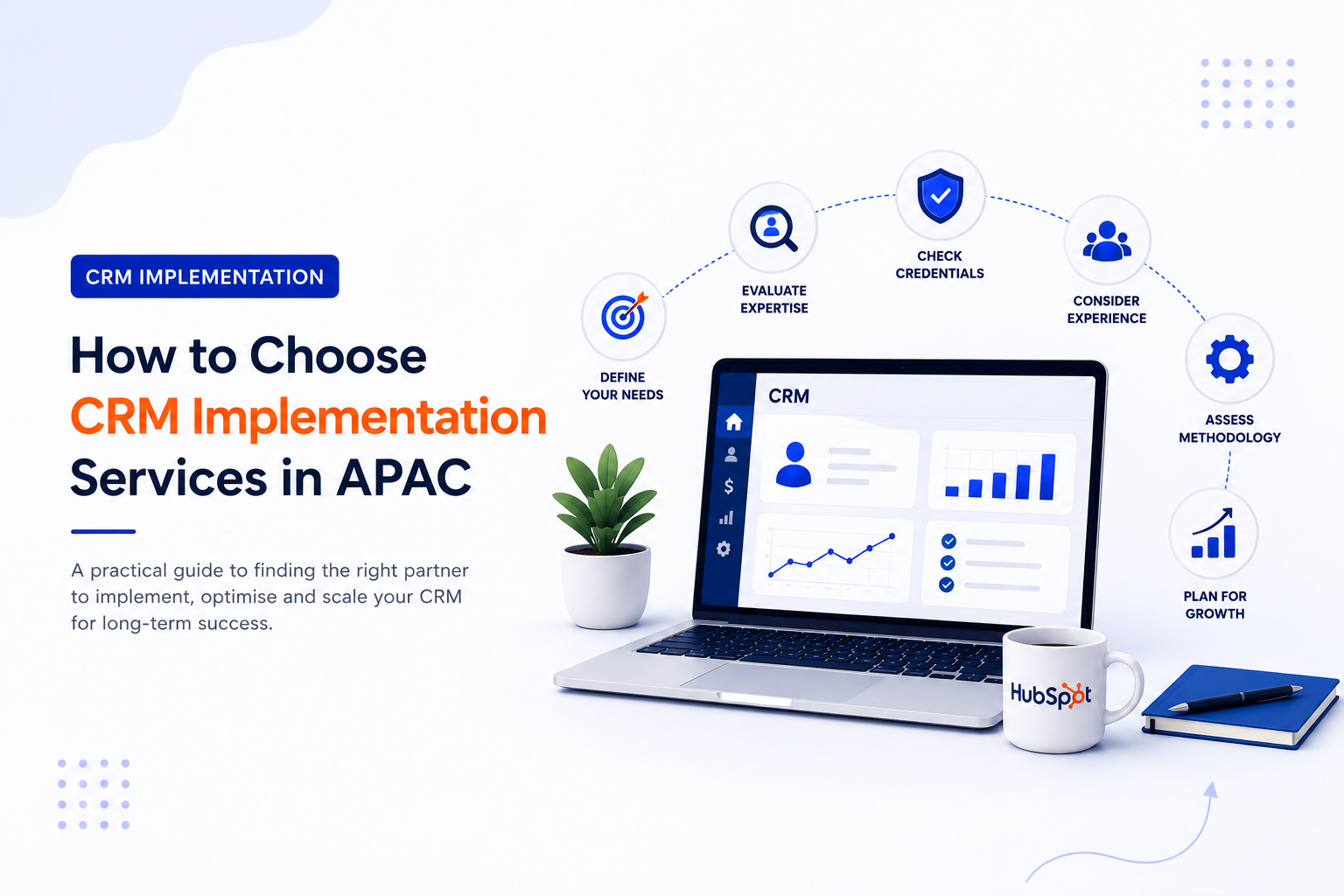
How to Choose CRM Implementation Services in APAC
-
Yaghsha Dawar
-
Jul 23, 2026 5:37:57 PM
Selecting the right CRM implementation services for your APAC business can determine whether your new platform becomes a growth engine or an expensive data warehouse. With regional compliance requirements, multi-country rollouts, and the need for marketing automation that connects your sales and service teams, the stakes are higher than ever for SMB founders and revenue leaders.
Team CloudSource, a HubSpot Diamond Partner in the top 2% globally, helps businesses across APAC implement CRM systems that align their revenue teams from day one. This guide walks you through everything you need to evaluate when selecting a CRM implementation partner for HubSpot marketing automation, data migration, multi-region deployment, and sales-service alignment in the APAC market.
Key Takeaways: CRM Implementation Services in APAC
- APAC businesses face unique CRM challenges including multi-country compliance, regional data residency, and diverse market requirements that demand specialised implementation expertise.
- Successful HubSpot implementations require a RevOps-first approach that connects marketing, sales, and service teams before configuring a single workflow.
- Data migration quality directly impacts CRM adoption rates, with clean, deduplicated data being the foundation for accurate reporting and forecasting.
- Team CloudSource delivers APAC-focused CRM implementation with local support, a 98.6% project success rate, and a Zero-Leak Guarantee™ that keeps your system reliable.
- Multi-region deployments succeed when you balance global consistency with local flexibility, including localised lead routing and region-specific automation rules.
What Are CRM Implementation Services?
CRM implementation services cover the full process of deploying, configuring, and launching a customer relationship management platform for your business. This includes initial strategy development, technical setup, data migration, integration with existing tools, team training, and post-launch support.
For APAC businesses, implementation services must address additional complexities. These include compliance with regional data protection regulations like Singapore's PDPA and Malaysia's PDPA, multi-language support requirements, and the need to route leads across different countries and time zones.
A qualified implementation partner does more than install software. They architect a system that reflects how your business operates, connects your revenue-generating teams, and scales with your growth across the region.
Why APAC Businesses Need Specialised CRM Implementation Partners
Implementing a CRM in APAC presents challenges that generic or US-centric partners often overlook. Regional market dynamics, regulatory frameworks, and business practices differ significantly from Western markets.
Data Residency and Compliance Considerations
Different APAC countries have varying data protection laws. Singapore's Personal Data Protection Act, Malaysia's equivalent legislation, and Australia's Privacy Act each impose specific requirements on how customer data must be stored, processed, and transferred.
Your CRM implementation partner should understand these requirements and configure your system to maintain compliance. This includes setting up proper consent management, data retention policies, and ensuring your chosen platform can host data in appropriate regional locations.
Multi-Region Lead Routing and Localisation
APAC businesses frequently operate across multiple countries, each with distinct sales processes and customer expectations. Your CRM needs automation rules that route leads to the right regional teams, trigger localised follow-up sequences, and track performance by market.
Without proper regional configuration, leads fall through gaps between country teams, creating the revenue leaks that cost businesses 5-15% of their pipeline annually.
Time Zone and Communication Challenges
Working with a partner on the other side of the world creates friction during implementation. Questions go unanswered for hours. Training sessions happen at inconvenient times. Issues that need immediate attention wait until someone wakes up.
APAC-based partners eliminate these delays with local support during your business hours, faster response times, and a deeper understanding of how regional businesses operate.
How to Evaluate CRM Implementation Services for HubSpot
HubSpot has become the platform of choice for many growing APAC businesses due to its connected approach to marketing, sales, and service. When evaluating implementation partners for HubSpot specifically, certain criteria matter more than others.
Partner Tier and Certification Level
HubSpot's partner program recognises agencies based on their track record of successful implementations and client outcomes. Diamond and Elite partners represent the top tier globally, demonstrating consistent delivery excellence across multiple hubs.
Look for partners with certifications across all the hubs you plan to implement. A partner certified only in Marketing Hub may not have the expertise needed for a Sales Hub and Service Hub rollout. Team CloudSource holds 40+ HubSpot certifications across Marketing, Sales, Service, CMS, and Operations Hub, plus RevOps and Breeze AI credentials.
Implementation Methodology
Ask potential partners to walk you through their implementation process. A structured methodology reduces risk and ensures nothing gets missed during setup. Red flags include vague answers, no documented process, or an approach that jumps straight to configuration without strategy.
A solid implementation framework typically includes distinct phases: discovery and audit, data migration and cleanup, hub setup and configuration, automation activation, and training with post-launch support. Each phase should have defined deliverables and milestones.
RevOps vs. Tool-First Approach
Many implementation partners treat CRM as a technology project. They configure the platform based on default settings and leave you to figure out how it fits your actual business processes.
RevOps-focused partners take a different approach. They start by understanding your revenue operations: how leads flow through your funnel, where handoffs happen between teams, what data you need for accurate forecasting, and where current processes create friction. The CRM configuration then reflects these real-world requirements rather than generic templates.
What to Look for in Data Migration Services
Data migration represents one of the highest-risk phases of any CRM implementation. Poorly migrated data creates problems that compound over time: duplicate records, incomplete contact histories, broken segmentation, and reports that nobody trusts.
Data Audit and Cleanup Before Migration
Your existing data probably contains issues accumulated over years of use. Duplicates, outdated records, incomplete fields, and inconsistent formatting are common in legacy systems and spreadsheets.
Quality implementation partners conduct a thorough data audit before migrating anything. They identify duplicates, establish rules for merging records, define which fields map to the new system, and clean obvious errors. According to CRM data migration research, organisations that skip data cleanup experience significantly lower user adoption and reporting accuracy.
Mapping and Validation Process
Data mapping defines how information from your old system translates to your new CRM. This sounds straightforward but gets complex quickly when dealing with custom fields, different data types, and relationships between records.
Your implementation partner should provide detailed mapping documentation and run validation checks after migration. These checks compare source and destination data to catch issues before they affect your live system.
Handling Historical Data
Decide early what historical data needs to migrate. Bringing over every record from the past decade might seem comprehensive, but outdated contacts and closed deals from years ago can clutter your new system.
Work with your partner to define what history matters for your business. Active deals, recent customer interactions, and contacts engaged in the past year typically provide value. Ancient records often just consume storage and slow down searches.
Multi-Region Deployment Considerations for APAC
Deploying a CRM across multiple APAC countries requires balancing standardisation with local flexibility. Too rigid an approach fails to accommodate legitimate regional differences. Too flexible creates data inconsistency and reporting chaos.
Global Template with Regional Customisation
Start with a global template that establishes core processes: standard deal stages, required contact properties, and consistent reporting structures. Then identify where regional variations make sense.
For example, your qualification criteria might remain consistent globally, but lead routing rules, follow-up sequences, and email templates need regional versions. Currency and date formats obviously vary by country. Sales cycles might differ based on local business practices.
Phased Rollout Strategy
Attempting to launch across all markets simultaneously increases risk. A phased approach starts with one or two markets, validates the configuration, incorporates lessons learned, then expands to additional regions.
This approach lets you catch configuration issues early, train internal champions who can support later rollouts, and build organisational confidence in the new system before asking everyone to change how they work.
Regional Admin and Support Structure
Even with a centralised CRM, regional teams need local support. Identify regional administrators who understand both the platform and local business requirements. These people become your first line of support and can handle routine requests without escalating to your implementation partner or central IT team.
How Marketing Automation Fits into CRM Implementation
HubSpot's Marketing Hub connects directly to your CRM, creating a unified view of how contacts move from anonymous website visitors through qualified leads to closed customers. Proper implementation ensures this connection works from the start.
Lead Capture and Routing Configuration
Marketing automation begins with capturing leads through forms, landing pages, chat widgets, and other conversion points. Each capture method needs proper configuration to collect the right information and create CRM records correctly.
Lead routing rules then direct new contacts to appropriate owners based on criteria like geography, company size, or product interest. In APAC deployments, these rules often include country-based routing to ensure leads reach representatives who understand local markets and speak relevant languages.
Nurture Workflows and Lifecycle Stages
Not every lead converts immediately. Marketing automation nurtures contacts over time through targeted content, building familiarity and trust until they're ready to engage with sales.
Your implementation should include lifecycle stage definitions that track where contacts sit in your funnel. These stages connect to automation triggers, ensuring marketing workflows hand off to sales activities at the right moment.
Attribution and Performance Tracking
Understanding which marketing activities generate revenue requires proper attribution configuration. HubSpot tracks touchpoints throughout the customer journey, but this tracking only works when implemented correctly.
Your partner should configure campaign tracking, UTM parameters, and attribution models that match your business needs. This enables marketing to prove ROI and make data-driven decisions about where to invest future efforts.
Achieving Sales and Service Alignment Through CRM
Revenue leaks often occur at handoff points between teams. A lead converted to customer but not properly onboarded. A service issue that nobody told the account manager about. An upsell opportunity that support identified but never reached sales.
Unified Customer View Across Teams
When sales and service work from the same CRM, everyone sees the complete customer picture. Sales knows about open support tickets before calling a renewal meeting. Service sees what promises sales made during the deal process. Nobody gets surprised by information another team had but didn't share.
This unified view requires proper implementation. Contact records need consistent data. Activity timelines need complete information from all touchpoints. Team members need appropriate visibility into each other's work without overwhelming detail.
Handoff Workflows and Automation
Manual handoffs between teams create delays and dropped balls. Automated workflows ensure nothing falls through gaps when responsibility transfers.
Configure workflows that trigger when deals close, creating onboarding tasks for service teams with full context about what the customer purchased. Set up alerts when service identifies expansion opportunities, routing them to account managers with relevant details. Automate renewal reminders that reach sales before contracts expire.
Shared Metrics and Accountability
Alignment requires shared understanding of success. When sales is measured only on new bookings and service only on ticket resolution time, neither team has incentive to support overall customer success.
Your CRM should track metrics that span team boundaries: customer lifetime value, net revenue retention, time to first value, and account health scores. Dashboards that display these shared metrics reinforce the connection between team efforts.
Questions to Ask Potential CRM Implementation Partners
Before selecting a partner, prepare questions that reveal their actual capabilities and approach. Generic marketing claims matter less than specific evidence of relevant experience.
About Their APAC Experience
How many implementations have they completed in your target markets? Can they provide references from businesses similar to yours? Do they have team members based in your region, or will you work with people in significantly different time zones?
About Their Methodology
What does their implementation process look like? How do they handle discovery and requirements gathering? What's included in their data migration approach? How do they measure implementation success?
About Post-Launch Support
What happens after go-live? How long does their support period last? What's included versus additional cost? Do they offer ongoing optimisation services for businesses that want continued partnership?
About Their Team
Who will actually work on your project? What certifications do those specific people hold? What's the team's average experience level with your chosen platform?
Common CRM Implementation Mistakes to Avoid
Learning from others' mistakes saves you from repeating them. These issues appear frequently in failed or troubled implementations.
Rushing to Configuration
Jumping into platform setup before properly understanding requirements leads to rework. Teams configure based on assumptions, then discover actual processes don't match what they built. Take time for proper discovery, even when stakeholders pressure for quick results.
Neglecting Change Management
CRM implementation changes how people work. Without proper change management, teams resist the new system, find workarounds, or simply don't use it. Plan for training, communicate benefits clearly, and involve end users in the process.
Over-Customising the Platform
Excessive customisation creates maintenance headaches and upgrade complications. Before building custom functionality, confirm standard features can't meet the need. Keep customisations focused on genuine business requirements, not preferences.
Inadequate Testing
Testing often gets compressed when timelines slip. This creates problems that emerge after launch, damaging user confidence in the new system. Build adequate testing time into your plan and resist pressure to cut it short.
How Team CloudSource Approaches APAC CRM Implementation
Team CloudSource brings a RevOps-first perspective to every HubSpot implementation, focusing on how marketing, sales, and service teams generate revenue together rather than treating each hub as a separate project.
The 5-Step Implementation Framework™ guides every engagement: Audit and Architecture, Data Migration and Cleanup, Hub Setup and Configuration, AI and Automation Activation, and Training with 30-Day Hypercare support. This structured approach has delivered a 98.6% project success rate across 50+ implementations.
As a HubSpot Diamond Partner since 2025, recognised in the top 2% globally, Team CloudSource has earned APAC's High Partner-Sourced Revenue award by consistently delivering outcomes that grow client businesses. Local presence across Malaysia and Singapore means faster response times and team members who understand regional business dynamics.
The Zero-Leak Guarantee™ ensures your CRM stays clean, accurate, and reliable after launch. Rather than handing over a system and disappearing, ongoing support options keep your HubSpot investment working as your business evolves.
In Conclusion: Selecting Your APAC CRM Implementation Partner
Choosing CRM implementation services for your APAC business requires evaluating partners on their regional expertise, implementation methodology, data migration capabilities, and post-launch support. The right partner understands that CRM success isn't about software features but about connecting your revenue teams around accurate data and efficient processes.
Start your evaluation by looking at HubSpot partner directories for Diamond and Elite partners active in APAC markets. Request case studies from businesses similar to yours. Ask detailed questions about their approach to data migration, multi-region deployment, and sales-service alignment.
Choosing the right CRM implementation partner is just the first step towards building a more efficient, revenue-focused business. Want to see where your current HubSpot setup may be holding you back? Join our live webinar on 30 July 2026, where we’ll uncover common revenue leaks and show you how to fix them.
FAQs
How long does a typical HubSpot implementation take in APAC?
Most HubSpot implementations take 4-12 weeks depending on complexity. Team CloudSource prioritises building a structured system that supports long-term growth rather than rushing through setup. Multi-hub implementations with complex data migrations typically fall toward the longer end of that range.
What does CRM data migration include?
CRM data migration includes auditing your existing data quality, mapping fields between old and new systems, cleaning duplicates and incomplete records, executing the transfer, and validating that everything arrived correctly. Team CloudSource handles end-to-end migration including data normalisation and deduplication to ensure you start with clean, reliable information.
Can I implement HubSpot if my team has never used a CRM before?
Yes, HubSpot works well for CRM-first implementations. Your implementation partner should provide structured training that builds team confidence. Team CloudSource includes live team training, admin training, playbooks, SOPs, and 30-day hypercare support to ensure everyone uses the system effectively from launch.
What's the difference between HubSpot implementation and optimisation?
Implementation creates a new HubSpot system or migrates from another platform. Optimisation improves an existing HubSpot setup that isn't delivering expected results. Team CloudSource offers both services, helping businesses whether they're starting fresh or fixing a problematic inherited portal.
How do I know if my business needs CRM implementation services?
You need CRM implementation services if your team currently tracks customers in spreadsheets, your existing CRM has poor adoption, or you're switching platforms. Signs include inconsistent follow-ups, no visibility into pipeline status, and teams working from different data sources. Team CloudSource helps diagnose these issues through free revenue leak audits.
What ongoing support is available after CRM implementation?
Post-launch support varies by partner. Team CloudSource includes 30-day hypercare with every implementation covering training reinforcement, workflow adjustments, and issue resolution. Ongoing managed services are available for businesses wanting continued optimisation, monitoring, and strategic guidance as their HubSpot usage matures.